
Where did you complete your training (or where are you still in training)?
I completed my training with Michael Stone, the developer of the NeuroDynamic Breathwork® modality.
What do you enjoy about breathwork and how has it helped you?
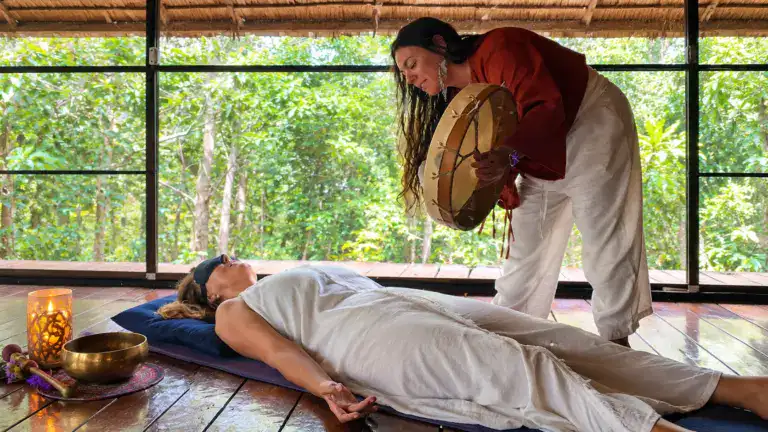
I enjoy breathwork differently at different times. Sometimes, I enjoy it as a release/relief of accumulated stress and tension. Other times, I enjoy the slightly altered states of consciousness it takes me to; still, to this day, it blows my mind that such power lives within us. I love it that it helps me reconnect with my body; same as most, my daily life keeps me in my head. But the part I enjoy the most is that it helps me to give myself permission to express what I otherwise suppress, free movement and sounds that are usually stuck in my throat.
Are you trained in any other modalities?
I completed my Personal Performance/Life Coaching certification with The Coaching Academy and am a member of and practice in accordance to the Code of Ethics of the Association for Coaching.
I am currently working towards my NLP Practitioner certification with The Coaching Academy.
How do they integrate with breathwork?
I use these other modalities to help people prepare for the breathwork experience and to integrate it and make sense of it after. Usually, it involves learning to notice emotions and sensations without judging, discussing setting or choosing not to set intentions, anchoring experiences, etc.
What is your personal journey?
For me, it all started about ten years ago when I decided I wanted to learn to stand on my head (spoiler: I never did, but I was soon happy to move on from trying), so I went out looking for a yoga teacher/instructor. The one I found – after a long search – made me sit and breath for three month before doing any yoga (back then, my understanding of yoga was that it was all about bendy poses). I felt surprised at myself for feeling compelled to keep going back because my sceptic brain kept telling me it was pointless. To this day, I can only assume that it was something else – maybe some sort of consciousness in my body? – that knew to compel me to go back every week. The moment I finally – at the beginning of the 4th month of classes – experienced the power that breath holds is described in detail in my ‘From Sceptic to … Practitioner’ piece but, in short, it felt like a Eureka! moment in the body, which then travelled up to my mind. I think it was the first time my body and mind connected; almost felt like one.
That experience opened me to everything else that followed. I ended up reading books and scientific papers about breath. I did my BSc dissertation research project on the associations between the practice of yoga and emotional intelligence, where I found that pranayama – the breath element of yoga practice – was positively associated with emotional intelligence while just doing yoga poses wasn’t. By then, my ‘sceptic’ has completely left, and I became a believer.
In 2021, I was diagnosed with Rheumatoid Arthritis (RA) and put on medication which I was told I’ll have to be on for the rest of my life. After researching and learning that, while nobody truly knows, the most prevalent theory is that RA is most likely triggered by prolonged exposure to stress and the resulting inflammation, I decided to be intentional about using certain breathing techniques that have been observed to interrupt the stress response cycle whenever I feel and/or observe stress symptoms manifest. I fully believe that learning to intentionally notice and apply certain breathing techniques continue to help me manage my RA symptoms.
Somewhere along the way, I encountered metaphysical ideas and the concepts around altered states while, simultaneously, continuing to explore various breathwork techniques and protocols, both theoretically and experientially. Arriving at deciding to train as a facilitator felt like the most natural, ‘was-always-going-to-happen’ thing.
Now, I am dreaming about being able to do a Phd so I can test my hypothesis that practicing altered states-inducing breathwork protocols in group/community of practice (as oppose to individually) would produce stronger and more sustainable therapeutic (in terms of mental health and subjective wellbeing) effects. I may be wrong, but I won’t know until it’s tested. Whether I’ll funding for this research, remains to be seen. But that’s the dream.
What do you stand for, and what do you stand against?
I stand against the pathologisation of human experiences of life and the world; that is probably my biggest pet peeve. In turn, I stand for advocating for raising our collective awareness of our embeddedness in our cultural and natural ecosystems and recognising that most of the things we experience aren’t things that are ‘wrong with us’ but, instead, that most of the times our experiences are our natural response and our relationship with the world around us. I feel that recognising that can alleviate the suffering and help us access our inner resources to become more discerning and more intentional in how we relate to the world around us and, most importantly, to ourselves.
What is your greatest wish for your clients?
My greatest wish for my clients is that they experience less suffering and more joy, and that they can lead an empowered life where they exercise their agency. My other great wish for my clients is that they regain and/or never lose the ability to notice things both inside and outside of them, so that they always have the capacity to feel awe.