
The Longest Advent
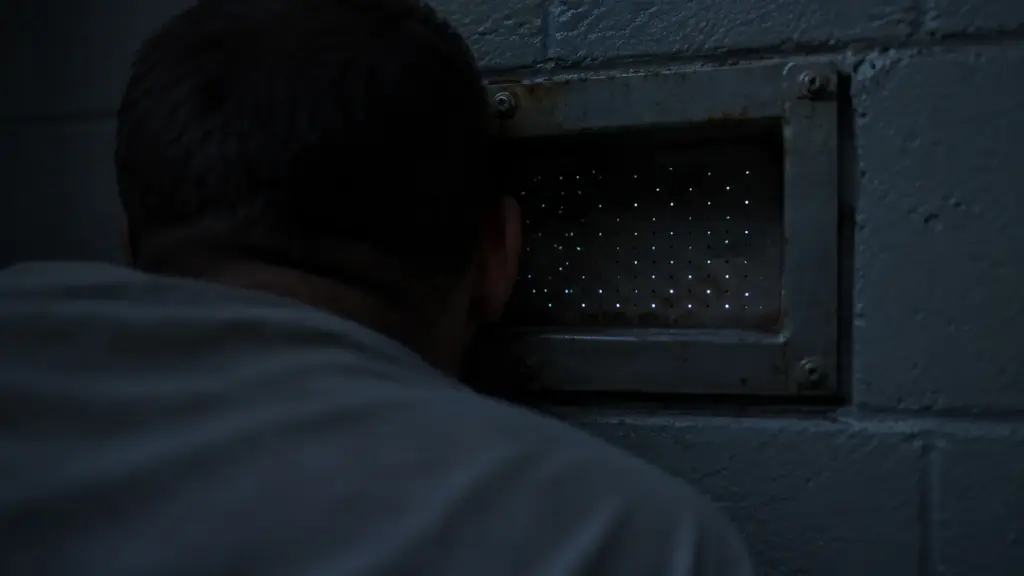
The window opening was only a few inches, into a metal box bolted to the outside wall, its sides pierced with holes no bigger than seeds. Holes so small that only a wisp of air could pass, but with it, the world. And out of those little wisps whole stories grew.
At night I’d push my head through the opening as much as I could. Into that cramped steel space and breathe in whatever the wind carried.
Some nights, it was the faint smell of chimney smoke – someone’s fire lit against the cold. And I’d build a whole story around it – a house, a kitchen, voices and characters, some I knew, some I didn’t. But all of them came to life. The stories were delivered to me like a letter posted in pieces.
Summers were the best.
The air would come in warm and heavy. It was scent-laden. I could often smell cut grass. The smell of warm concrete and distant tarmac. I could also feel the long light of the evening. And it brought with it everything I was missing: people out walking, doors left open, children playing till sundown, evenings with no end to them.
The same holes that let the world in also reminded me how far away it was.
I couldn’t escape the knowledge that I would never be immersed in the majesty of that summer evening. When the light went, and dusk came, I’d still be here, in the same eleven-by-thirteen-foot space I’d occupied for years. For my first few years inside, I’d been oblivious to what lay just beyond the window, or aware of it, just unable to reach it because the cell windows were blocked. But now I had my own cell and a functioning window. And with it, a whole spectrum of scents waited only a couple of feet away. I’d managed to work my head and nose about halfway into the space, and breathing there for some time was like going for a walk. For a moment, I was a free man.
I could be going anywhere. Even just a stroll around the block in my head was enough to make my evening. Some evenings I’d go to the window more than once, and those walks around the block could turn into adventures. My imagination could carry me to the mountains, to the sea, a market halfway around the world. The prison cell stayed the same size, but the world I walked through each evening had no walls or bars.
And yet, the nicer the weather and the sweeter the air, the heavier the sadness that often came with it. Some nights it would hit me hard. I’d put my nose to the window as always, and the only thing that reached me was the smell of confinement: restriction, loss, grief. Grief for the life I’d lost, a life I knew would never be the same, even if I did one day return to it. Those were the bad nights. But I didn’t allow them to rob of this little bit of joy
It took years for me to find words for what that window had taught me, and when I did, they came from the poet Patrick Kavanagh. To a poem I had first encountered in school, whose imagery had never left me. In his poem “Advent,” he writes, “Through a chink too wide, there comes in no wonder.” Kavanagh was writing about the weeks before Christmas, a season of fasting and going without. He believed that when we’ve seen and tasted too much, the world goes flat on us. It’s only by narrowing what comes in that we get back a child’s capacity to be amazed. He chose his narrowing. Mine was chosen for me, eleven feet by thirteen, with a steel box of holes for a window. But I think I understood him there better than I could have anywhere else. The gap was small, but my imagination was infinite.
If my window was the narrowest chink imaginable, the phone in my pocket today is the widest – a screen that opens onto everything, at any time. It’s an extraordinary thing, but it comes at a cost. The phone does a lot of things for us, and to us. And one of them, quietly, is shutting down our imagination. When everything arrives complete, there’s nothing left for the mind to create. There’s no gap for wonder to come through. Kavanagh saw this coming long before any of us carried a screen. Through a chink too wide, there comes in no wonder. I learned it with my face pressed against a metal box, breathing in the night air. I wouldn’t wish that window on anyone. But I wish everyone the wonder that came through it.