
I’ve always felt that there is something rather wonderful about our old Irish stories.
We might first encounter them as children, listening to tales of enchantments, extraordinary journeys, ancient heroes and creatures who move between the human world and the Otherworld. We learn the names, remember the magic, and perhaps put the stories away as we grow older.
But I wonder if we sometimes put them away too soon.
Because when we return to these stories with a few more years of living behind us, we often find something we didn’t notice before.
The characters are not always wise or good. They make mistakes. They love, envy, betray, protect and grieve. They lose people and places they thought would always be there. They face choices they never expected to make, and sometimes there is no happy ending.
Rather like life itself.
I don’t believe these stories exist simply to teach us lessons, and I would be reluctant to reduce them to tidy messages about how we should live. Their richness lies partly in their contradictions, their mysteries, and the different ways they have been told and understood over generations.
But I do believe they can help us look at our own lives a little differently.
Sometimes a story gives us enough distance to approach something that might feel too difficult to look at directly. We can wonder about the choices a character makes, recognise something of ourselves in their struggles, or discover that a question we thought was ours alone has been asked, in one form or another, for centuries.
And perhaps the story changes with us. What spoke to us at twenty may be very different from what we hear at fifty or seventy.
The Children of Lir is one of those stories for me.
Most of us remember the four swans, the cruel enchantment and the nine hundred years of wandering. A beautiful, sorrowful story, with a spell at the beginning and a bell at the end.
But these days, I find myself drawn to what happens in between.
To the long years of living with a change that cannot be undone. To the love that remains, the grief that changes shape, and the small acts of care that help four lost children survive.
And, perhaps, to what their story might tell us about our own lives.
Because I am coming to believe that grief doesn’t always pass so much as change.
Four Children and a Jealous Queen
Lir was one of the Tuatha Dé Danann, the old people of Ireland’s stories. When his wife died, he was left with four children: Fionnuala, the eldest, her brother Aodh, and the twins Fiachra and Conn. His grief was large, and so was his love for them. Bodb Dearg, the king, saw how heavily it sat on him and offered him another wife, Aoife, the sister of the one he had lost.
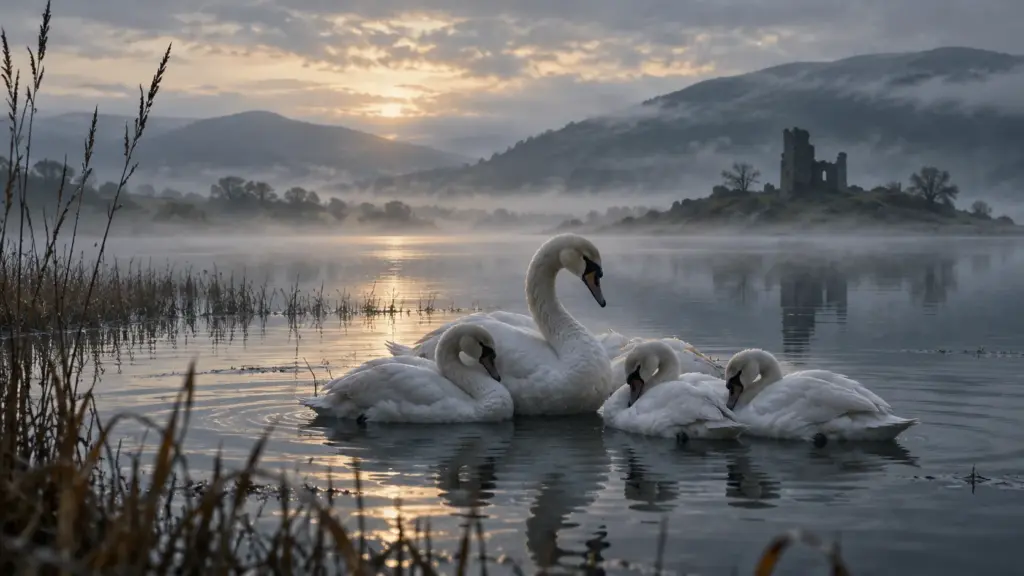
At first Aoife loved the children too. But Lir’s heart stayed so full of them that something in her began to sour. Jealousy grew slowly, the way damp does in a house nobody airs. In time she took the four of them to Lough Derravaragh, a still lake in the midlands, telling them they were going to bathe. At the water’s edge she struck each one with a druid’s wand and turned them into four white swans.
They did not lose themselves in the change. That’s the part I always come back to. They kept their own minds, their own memories, and their own human voices. Aoife set their sentence at nine hundred years: three hundred on Lough Derravaragh, three hundred on the Sea of Moyle, and three hundred on the waters off Inis Gluaire in the west. The spell could only end when a king of the north married a queen of the south, and when a bell rang across the water.
They also kept one thing she couldn’t take from them. They could sing, and their singing was said to be the sweetest sound in all of Ireland. A voice is only breath given shape. Whatever else was taken from them, the breath was still theirs to send out across the water.
The Long Cold
The first three hundred years were the gentlest. Lir and the people of the Tuatha Dé Danann came to the shore, and the swans sang to them, and for a while it must have felt almost bearable. Grief is sometimes easiest to carry when it is shared and witnessed.
Then the sentence moved on. The Sea of Moyle, the narrow, stormy water between Ireland and Scotland, was another thing entirely. There were gales, and ice that locked the sea around them, and nights so cold their feathers froze to the rock. In one storm the brothers were swept away from Fionnuala, and she was alone, and had to wait for them to come back to her.
When they did, battered and frozen, she did what she’d always done. She opened her wings and gathered her brothers beneath them. I think of that image often. Three bodies pressed against one, each breath warming the next, the small shared weather of four creatures breathing close together against a long night. She couldn’t turn the sea back, or undo the spell, or make the cold any less cold. What she could do was shelter them, breath by breath, until morning.
The final three hundred years, off the western island of Inis Gluaire, are told more quietly still. By then the story seems to say there was little left to narrate. Just the water, and the years, and four swans who had learned how to keep going.
What the Waiting Asks
Transformation, in this story, isn’t the hard part. It happens in a moment, with a touch of a wand. The hard part is everything after: the nine hundred years of being changed, and missing what was before, and still having to get through the next winter.
I think that’s worth saying plainly, because we tend to imagine grief as something that passes. That if we do the work, it will lift, or release, or we’ll come out the other side and leave it behind. A new chapter, a new self, a different life on the far side of a loss. And sometimes those things do come. But the children of Lir were utterly transformed, bodies and all, and they were still grieving. The change didn’t remove the ache. They carried it into the new shape, with their own minds and their own voices, for centuries.
And notice what happened to it there. It didn’t stay exactly as it was. In the swans’ bodies, on those cold waters, the grief became something else: slower, wider, less an event happening to them than a way of being in the world. It was still grief. It had simply changed.
Grief like that doesn’t ask to be solved. It asks for something much older and plainer. Pacing. The willingness to take the next breath, and then the one after it, without any promise about when it will lift. A held breath is how most of us begin a grief, shoulders up, chest tight, bracing for the next thing. But nobody can hold a breath for nine hundred years. At some point it has to move again. The swans’ singing, I think, is that movement. Not grief released and gone, but grief changed into something that could be offered: shaped by the breath, steady and long on the exhale, sent out across the water rather than clenched inside the chest.
And a breath that leaves the body doesn’t end anything. Another one arrives. Grief, I think, is more like that than like a weight set down once and for all. It comes and goes, deeper on some days and shallower on others, and with enough time it changes the way it moves through us.
And Fionnuala, the eldest, who shelters everyone else, is a figure I think many of us know from the inside. If you’ve spent years being the one who gathers the others beneath your wings, a teacher, a mother, a carer, the one who stays steady so someone else can sleep, you’ll know how long a single night can be. The story doesn’t tell us what she needed. I find myself wishing someone had gathered her too.
The Bell
When the end finally comes, it comes quietly. A hermit named Mochaomhóg lives on Inis Gluaire, and the swans hear his bell ring across the water. By then, in the story, a king of the north has married a queen of the south, and the old conditions have been met. The spell loosens. The feathers fall away.
It isn’t a joyful ending, and I don’t think it was meant to be. Nine hundred years arrive in an instant. The four of them are old, withered, human again, and at last they are allowed to rest. The surviving written versions of the tale come from the late medieval period and were shaped by Christian hands, which is why the bell is a monk’s bell and why the ending turns toward baptism. But the shape underneath it is older, and I think it’s true: the bell doesn’t end the grief. It ends the sentence. It doesn’t give back the years, and it doesn’t undo what was lost.
And look at what they ask for as the end comes. In the versions I know, they ask to be buried together, close, with Fionnuala at the centre and her brothers around her as they had always been. Even at the very end, the shape of the love they lived in is the same. What they carried had changed form many times across nine hundred years, from shock to ache to song to simple company. It was never put down and left behind. It was carried to the end, and it was carried together.
The story is traditionally counted among the Three Sorrows of Storytelling, alongside the tales of the Children of Tuireann and the Children of Uisliu. I understand why. It doesn’t hurry anyone toward comfort.
What I Take From This
I take from it that grief isn’t a problem waiting for the right technique, and it isn’t something that passes or is finally released. It changes. It’s more like weather, or like water: it has its seasons, its storms and its long grey calms, and the water that was ice in the dead of winter runs free in spring and is still the same water. You are not failing if the ache has come with you into a new life. Sometimes we change completely and carry the grief anyway, in our own voice and our own mind, and over time the carrying changes too.
What helps, in the end, is small and close to the body. Someone to shelter beside. A breath that is allowed to be as long or as short as it needs to be. A song, even a quiet one, sent out across the water. And the slow trust that the way you carry it will keep changing, even if it never entirely leaves.
If you are somewhere in the long middle of your own grief, and it hasn’t lifted, nothing has gone wrong. You are welcome to take your time. Nothing here needs hurrying.
Go mall agat féin.