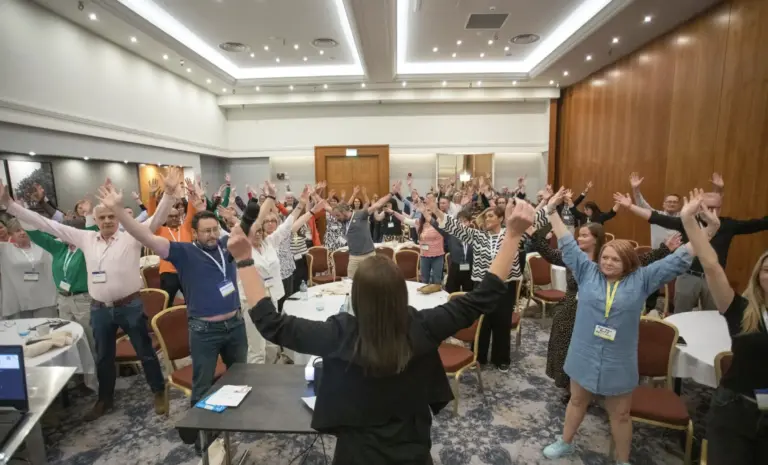


I’ve been doing a few stalls recently. Menopause days, wellness events, the kind where you set up a table and talk to people as they wander past.
It’s funny how people tell you things when you’re stood on one place for long enough.
Quick things, in passing, often on their way somewhere else. After a while I started noticing that a lot of them were saying the same four or five sentences.
Not for people like me. Too late for me now. Tried it once, wasn’t for me. I can’t, because of how I am.
What struck me was that almost nobody saying these things had tried the thing they were ruling out. They weren’t reporting back from experience. They’d already decided.
I want to look at four of them, because I think some are partly our doing as a field.
One: Is it only for women? Only for menopause?
This was the one I was asked most, which makes sense given where I was standing.
I talk a lot about midlife and menopause, so the assumption is reasonable. That’s my own doing, and it’s genuine, because that’s a lot of who I work with and a season I’m navigating myself.
But what I notice underneath the question isn’t curiosity about my booking policy.
I feel that it’s people checking whether they’re allowed…. are they welcome?
Whether there’s a version of this that includes them.
Which is worth sitting with, because we all niche in some way, whether we mean to or not. And every time we describe who our work is for, we are also, by implication, describing who it isn’t for.
You’ll hear plenty of marketing coaches say the niche is essential. I find it hard to do, personally, because I tend to respond to what’s actually in front of me and what the person needs. But a style comes through anyway. A transmission, if you will.
So perhaps it’s less about having a niche and more about knowing who feels right to work with, and who might be better served elsewhere. Then when the question comes up, as it will, you’ve a better chance of answering it well.
Two: Isn’t it too late for me?
The second comes up constantly, and not only about breathwork. Too late to get fit. Too late to learn. I’m too old now, this is how I am.
There’s something almost funny about it applied to breath. How is it ever too late to learn to breathe? You’ve been doing it your whole life. You’re doing it now. This isn’t a new skill from scratch, it’s paying attention to something you’ve done since the day you were born.
I understand the belief, mind you. I didn’t start lifting weights until I was thirty-four and was convinced that being over thirty meant I’d missed my chance. Everything I went on to do came after the age I’d already written myself off at.
Three: It’s just not for me
This one is more interesting, and it asks something of us.
People say, I tried breathwork once and it wasn’t my thing. And I believe them. That happens, and it’s allowed.
But here’s what I’d offer, and it isn’t something people in our position always say out loud.
Not every facilitator is right for every person. I am not right for everybody. There will be people who come to one of my sessions and find my way of working doesn’t suit them at all. Something about my pace, my voice, how I hold a room. I don’t believe this is a failure on either side.
When someone says breathwork isn’t for me, quite often what happened is that one session, with one person, on one particular day, wasn’t for them. Which is a completely different sentence.
I think we could be quicker to say this. Partly because it’s true, and partly because the alternative is that someone has a mismatched experience and closes the door on an entire modality. One data point becomes a lifelong conclusion.
Saying out loud that we’re not for everyone costs us almost nothing, and it leaves the door open behind us for whoever is a better fit.
Four: I can’t, because I can’t sit still
This fourth one comes up a lot, often from people who have ADHD or think they might.
And I’d suggest this one is largely our own making.
Think about how breathwork is usually pictured (ok stockfootage has a lot to answer for here).
Still bodies on mats. Eyes closed. Nobody moving. Serene, soft-focus, entirely motionless. That’s the image we put out, over and over, and then we wonder why people who can’t lie still for an hour assume there’s no room for them.
In my sessions people move. They fidget. I keep a good collection of fidget toys, just so you know. People shift about, stretch, change position, roll onto a side, and I actively encourage it. If the body wants to move, move. The only thing I ask is that they stay safe and don’t leap up suddenly, because dizziness after a period of focused breathing is real.
But the idea that you must lie perfectly still like a well-behaved statue for an hour is not a rule I have ever made. I doubt many of us have. We’ve simply never said otherwise.
I say this as someone with ADHD. Breathwork has been one of the most supportive things I’ve found, and not in spite of it, and not by making myself sit still. It gives me a way of being with myself that doesn’t require stillness to work.
And yes, I do see the irony of running a studio called Still Space. I don’t mean physical stillness. I mean the still space inside, the one you can carry with you even while leaping around. Just not immediately after a breathwork.
What they have in common
Each of these is the same move. A decision made in advance, dressed up as a fact about ourselves, that we’ve never thought to question.
These sentences can feel like information. They might feel like being realistic, or self-aware, or saving yourself some wasted time. They don’t always feel like decisions at all. They feel like facts.
But a lot of them are untested. Formed years ago from one experience, or something somebody said, or an assumption about what the thing involves that may not be accurate. Or may not be accurate anymore.
Each one sounds like a door closing, even if softly. No announcement. You just stop considering something, and over time your world shrinks a little.
Something to pass on
The practice I’ve been offering isn’t a breathing technique, and it may be useful to those you support too.
Notice when you say one of these sentences. I can’t do that. That’s not for me. It’s too late. I’m not the sort of person who does that.
You don’t have to challenge it or do anything about it. Just catch it, and then ask one question. Is that really true?
Not whether it should be true. Just, is it? Do I know that, or have I assumed it? Have I tried, or have I decided without any data behind it?
Sometimes the answer is yes, it’s true, and that’s completely fine. Good. You caught it, you checked it, nothing needs to change. Not everything is for everyone.
But often the honest answer is, actually I don’t know. I’ve just always said it that way.
The ones who aren’t in the room
Most of what we talk about as facilitators concerns the people in front of us. How we hold a session, how we support integration, what to do when something surfaces.
But these four sentences belong to the people who never arrive. Who decided, somewhere along the line, that this wasn’t for them, and were never in a position to find out otherwise.
Some of that we can’t reach. But some of it is ours. The way we picture our work. The way we describe who it’s for. The quiet implication, in all those serene motionless images, that there’s a right way to be in the room.
Worth a thought, next time we’re choosing what to put out into the world.