
There’s a version of this story most people know only as far as the thumb. A boy burns it, sucks it, and suddenly knows everything. It’s told like good luck. I don’t think it was.
Seven Years by the River
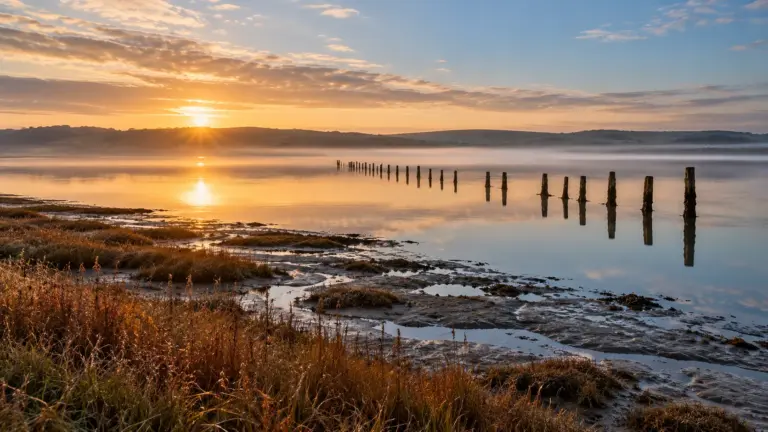
Finnegas had lived beside the River Boyne for seven years by the time this story properly begins, and every one of those years had the same shape. He watched the water. He set his lines. He waited.
He was a poet, one of the old kind, for whom knowledge and wisdom were never quite the same thing. Knowledge could be given, all at once, the way this salmon was rumoured to give it. Wisdom couldn’t. Wisdom had to be grown, the way a tree is grown, one patient season at a time. That’s not simply how this story frames it. It’s how the filí were actually trained. Years of learning came first, the histories, the genealogies, the law, the metres, and only after that came the long stretches of silence: sitting with what had already been learned until it stopped being memorised fact and settled into something a person could actually draw on when it mattered. By the time Finnegas came to that river, his years of learning were long behind him. What he was doing there, all seven years of it, was the silence, sitting with everything he already knew, letting it settle further, breath by breath, into something more than he’d been taught.
But wisdom alone wasn’t going to be enough for what he was actually for. A filí wasn’t only meant to hold things well. He was meant to be asked things, and to answer, and answering needed something to answer with. If someone came to him with a question about the year ahead, or the law, or what a strange dream meant, his capacity to hold knowledge beautifully counted for very little if there was no knowledge yet inside him to give them. Wisdom with nothing to apply it to is a vessel nobody can drink from. He needed the knowledge itself, not instead of the wisdom he’d already grown, but because his whole vocation depended on eventually having both.
So he sat by the water and breathed with it, slow and unhurried, the way you learn to when you’ve stopped expecting anything to happen quickly, and waited for the one thing his years of silence alone could never give him. It was said that far upstream, over a hidden well, grew nine hazel trees, and that their nuts fell into the water and were eaten by a single salmon living below, and that whoever ate that salmon in turn would carry the whole of the world’s knowledge inside them, all at once, forever.
Seven years is long enough to stop believing something will happen and keep watching for it anyway. That’s what patience actually is, I think. Not certainty. Just staying.
Then, on an ordinary morning that must not have felt ordinary at all, he caught it.
What Happened at the Fire
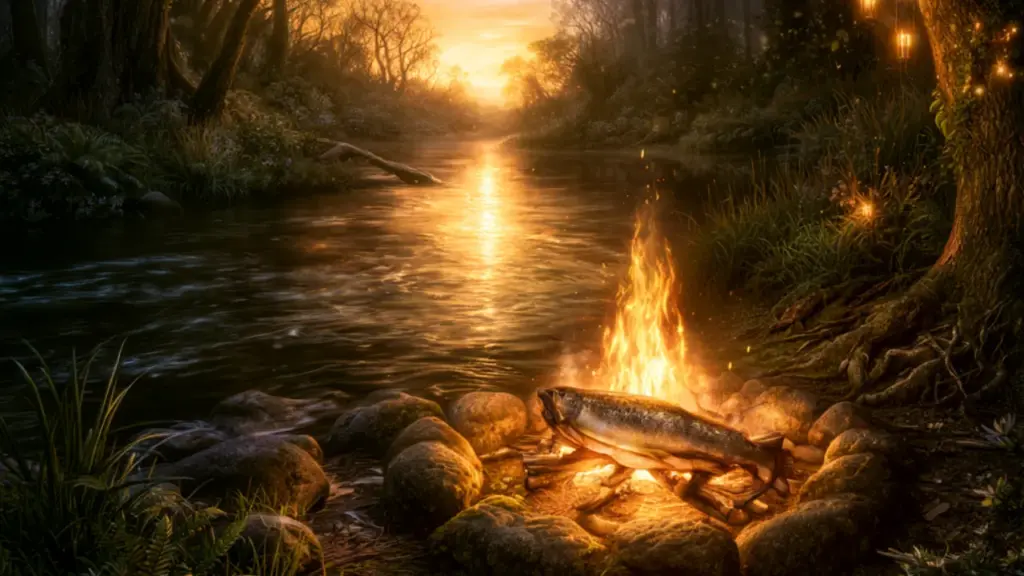
He had a boy staying with him at the time, Deimne, sent to him for fosterage and teaching, a boy who would only later become known as Fionn. Finnegas gave the boy one task: build the fire, cook the salmon, and do not, under any circumstance, eat any of it. Seven years of waiting had earned him that fish. He wasn’t about to lose it to carelessness.
The boy did as he was told. He built the fire. He laid the salmon over it. And he watched it cook, breathing the ordinary way anyone breathes while minding a fire, unremarkable, unhurried, thinking of nothing in particular, as the skin tightened and a blister slowly rose on its side, the flesh underneath beginning to spit and hiss.
Without thinking, the way you never think about it, the way a hand simply moves, he pressed his thumb against the blister to press it down. The heat went straight through him. And the boy did what anyone does with a burnt thumb. He put it in his mouth.
That was all. A single, unthinking motion, over before it had properly begun, faster than a breath could complete itself. And in that instant, everything Finnegas had waited seven years for arrived in the boy instead. Not slowly. Not in pieces. All of it, at once, the way water fills a cup dropped whole into a river.
When Finnegas came back to the fire and looked at the boy, he knew immediately that something had changed in him. He asked if he’d eaten any of the salmon. The boy said no but told him, honestly, about the burn, and the thumb, and the mouth. And Finnegas understood. The prophecy hadn’t broken. It had simply chosen someone he hadn’t expected it to choose.
I keep noticing what’s missing from that exchange. Finnegas had spent seven years growing the wisdom that was meant to hold this knowledge once it came, training his breath to be still enough to receive it properly. The boy received the knowledge itself without any of that. No stillness sought. No patience practised. Nothing offered in exchange but an ordinary reflex. He got the facts the salmon carried. He didn’t get the seven years that were meant to come with them. That’s part of what makes it feel less like a gift and more like something that simply happened to him, knowledge arriving with no wisdom yet built to receive it.
What Finnegas Lost
I think this is the part of the story worth sitting with longest, and it’s the part most tellings rush past the way I did the first time I read this.
Finnegas didn’t get angry. He gave the boy the rest of the fish to eat properly, sealing what had already happened. But I don’t believe that cost him nothing. Whatever peace he made with it, he must have felt something give way in him, watching a boy receive by accident, in less time than it takes to yelp from a burn, what he himself had spent seven years of mornings and winters reaching for.
That’s a loss too, even though the story doesn’t linger on it. Not every ending in a myth belongs to the one who walks away wise.
And yet I don’t think Finnegas actually lost everything that mattered. He lost the knowledge, the salmon’s particular gift, the thing the prophecy had named all along. But the wisdom he’d spent seven years growing was never only a vessel built to hold that one fish. The patience, the stillness, the trained breath, these had already changed how he lived, breath by breath, for seven years before the salmon was ever caught. That’s not nothing, and it’s not a consolation prize either. Wisdom is worth having for its own sake, whether or not the particular knowledge it was reaching toward ever arrives. Finnegas kept the truer of the two things he’d been growing that whole time. If there’s grief in it, it isn’t that his wisdom turned out empty-handed. It’s only that, this once, it didn’t get to meet the knowledge it had hoped for.
What It Cost the Boy
But I don’t think Fionn came away untouched either, even though he’s the one remembered as fortunate.
Knowledge that arrives before you’ve done anything to earn it doesn’t come with the years that would have taught you how to carry it. Finnegas had grown his wisdom slowly, the way most of us do, a little at a time, each piece tested against a life already being lived alongside it. Fionn got the knowledge whole, at once, with none of the wisdom that was ever meant to arrive alongside it.
And I don’t think it’s really knowledge that changed hands beside that fire, either, not simply. Before the burn, he was a boy called Deimne. After it, in every way that matters, he was becoming Fionn. What arrived didn’t sit inside him as separate facts he could set down and pick up later. It made him into someone else, whole and at once, the way a single moment sometimes does, knowledge behaving like transformation, because there was no wisdom yet in him to hold it as anything smaller.
That’s a harder thing to survive than information. You can take in new facts without becoming a different person by morning, that’s what knowledge alone usually allows you to do, held at a little distance, examined, put to use in your own time. But there was no wisdom in him yet to hold it at that distance. It rearranged him instead. And a rearrangement that happens faster than a breath doesn’t come with the years most of us need to grow into whoever we’re becoming, the slow accumulation of small, ordinary days that usually lets a person catch up with their own change, the very days Finnegas had spent seven years walking through, and Fionn hadn’t.
Notice, too, what he had to do for the rest of his life, whenever he needed to reach that knowledge again. He had to go back to the wound. Fionn’s thumb, bitten or pressed to his teeth, became the way he called on that knowledge in every story that followed. I like to imagine, though this part is mine, not the old story’s, that he never simply reached for it. That he paused first, and breathed, one slow breath before the thumb ever touched his mouth, as if some part of him kept trying to give the moment the wisdom it never had the first time. The knowledge had arrived without a single breath prepared for it. Every time after, perhaps, his body insisted on one anyway.
I don’t think that’s incidental. Sudden knowledge, sudden becoming, they seem to ask you to keep returning to however they first arrived: a burn, a break, a breath caught too fast to prepare for. The instant itself passed in less time than an exhale. What it left behind, he spent a lifetime learning to hold, still without the wisdom that would have made the holding easy.
What I Take From This
I don’t think this story is telling us to distrust sudden knowledge, or to wish only for the slow, earned wisdom instead. Both men are true in it, the one who spent seven years growing what he’d need to hold his knowledge well, and the boy who was made into someone else in the time it takes to flinch, with no wisdom yet grown to meet it. Neither is wrong. But neither is free of what it cost him, either.
If you’ve ever been changed all at once, not just handed knowledge you didn’t work for, but made into someone slightly different before you’d caught your breath, you might recognise something of Fionn in that. Not luck, exactly. More a wound you’ll likely return to, gently, for the rest of your life, each time you need to touch what it made of you, and each time, perhaps, still growing a little more of the wisdom that never got to arrive alongside it in the first place.
Go mall agat féin.