

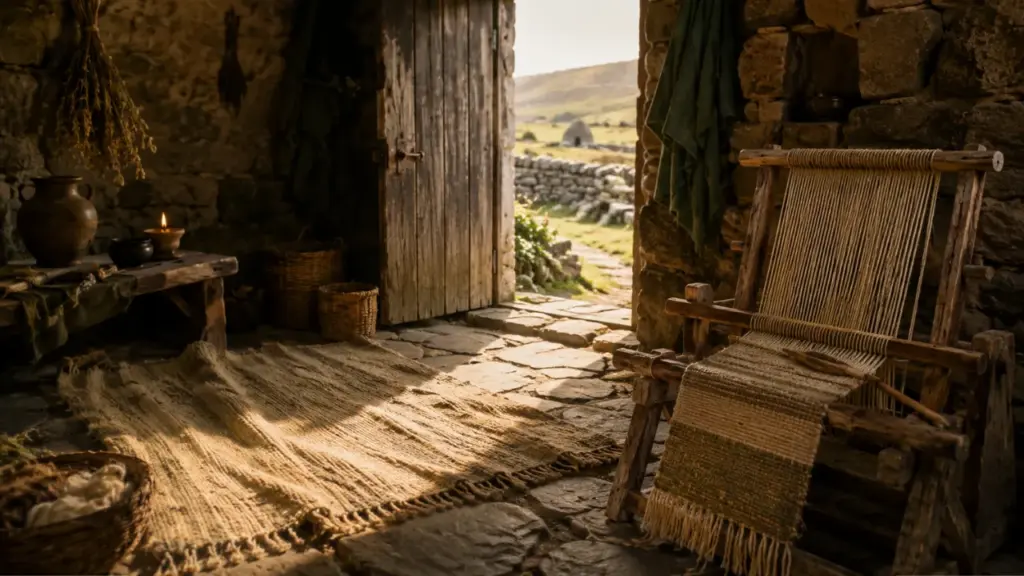
There’s a version of this story I could tell you that would be tidier than the truth. I could tell you the old Irish laws simply declared rest a right, full stop, the way we might wish for now. But that isn’t quite what the manuscripts say, and I’d rather give you the real thing than the comfortable one.
What Was Actually Written Down
In the law tracts known as Bretha Crólige and Bretha Déin Chécht, part of the great collection called the Senchas Már, there’s a practice called othrus, sick-maintenance. If someone was wrongfully injured, the person responsible didn’t simply pay a fine and walk away. They were legally bound to fund the injured person’s recovery. Housing suited to their status. Food for them and their household. And this is the part that stops me every time I read it, someone to carry out their duties while they healed.
The injured person wasn’t expected to convalesce in the gaps around their responsibilities. Their responsibilities were lifted from them, by law, and carried by someone else, for as long as recovery took.
I won’t pretend to you this was a blanket right to rest for anyone, any time, for any reason. It wasn’t. It was tied to injury, to harm done by another person, and it sat inside a hierarchical legal system that treated people very differently according to their status. I’d be doing exactly what I ask others not to do, dressing something up as more than the source allows, if I told you otherwise.
But here’s what it does show, plainly and reliably: this was a society whose law-makers understood, and wrote into binding legal text, that a recovering body cannot be expected to hold its old workload at the same time. That healing needs the whole shape of a life rearranged around it, not squeezed into whatever’s left over.
What This Has to Do With Breath
I think about breath here more than anywhere else in this practice.
When something in us is unwell, not always injured in the way the law meant, but genuinely worn down, the breath is usually the first thing to tell on us. It goes shallow. It goes fast. It forgets how to reach the bottom of itself. The body, quietly and without asking permission, starts rationing.
Othrus, as a legal idea, is what happens when a whole community agrees to stop asking a person to override that signal. No one was expected to breathe shallow and keep working anyway. The law itself made space for the deep breath to come back because someone else had picked up what the injured person could no longer carry.
We don’t have that structure now. No one is legally bound to take on our work while we recover from what’s worn us down, whether that’s injury or simply the slow grind of giving too much for too long. But I think the breath still remembers what othrus knew. It still asks, quietly, for the same thing, space, held by someone or something else for a while, so it can return to its full depth.
What I Take From This, Honestly
I’m not going to tell you the old Irish law solved rest, or that our ancestors had some perfect wisdom we’ve simply forgotten. What I’ll tell you instead is smaller and, I think, more useful: they understood that rest isn’t something a person can grant themselves while still holding everything else. It has to be built into the structure around them, legally, socially, practically, or it doesn’t really happen at all.
That’s not nostalgia. That’s just what the manuscript says, and it still holds true.
If your own breath has been running shallow and fast for longer than you’ve let yourself notice, you don’t need an old law to give you permission. But it might help to know that somewhere, a long time ago, people believed this so firmly they wrote it into what they owed each other.