

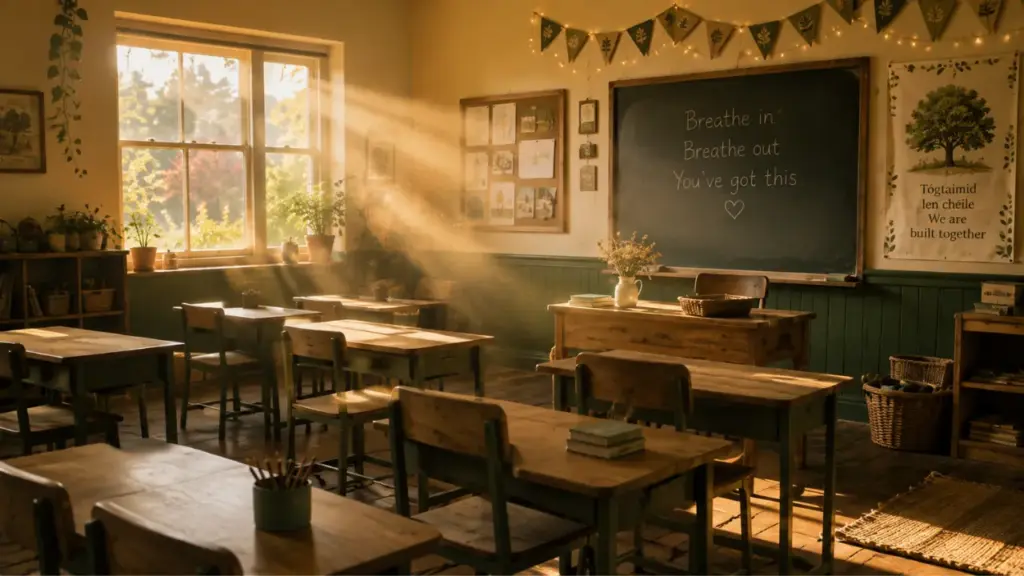
I didn’t have the words for any of this back then. When I started I had thirty children, a blackboard, and a body that was learning something I couldn’t have named if you’d asked me to.
There’s a word for what my body was doing, though it would be years before I learned it: felt sense. That whole-body knowing that arrives before language does, sensed first, understood only afterward, if you’re ever lucky enough to be handed the words for it at all. Mine arrived constantly, all through those years. I just had nowhere to put it.
The Room Before the Room Knew It
You can tell what a classroom is about to do before it does it, if you’ve spent long enough standing at the front of one. Not through anything anyone says. Through breath.
A room that’s about to tip into chaos has a particular sound to it, not loud yet, just quicker. Shallower. A kind of held-in busyness in thirty small chests at once. That was felt sense too, arriving in me long before I had any language for what I was noticing, letting me feel the shift arrive in the air before it arrived in behaviour. And I learned, without ever deciding to, that the fastest way to change it wasn’t to raise my voice. It was to change my own breath first, and let the room follow.
I didn’t know that’s what I was doing. I just knew it worked.
What My Own Breath Was Doing
The part I’m more honest about now, the part that took longer to see, is what was happening in my own chest during all of this.
There were years, many of them, where I held my breath through entire days without noticing. Walking into a difficult parents’ meeting. Standing in front of an inspector. Managing a child in real distress while thirty other children watched to see whether I could hold it. My breath went high and shallow in all of those moments, and I didn’t think of it as breath at all. I thought of it as just being a teacher. As what the job asked of a person.
It took me a long time to understand that my body was telling me something true in those moments, and that I’d simply trained myself not to listen. The held breath wasn’t weakness. It was felt sense doing exactly what it does under sustained pressure, day after day, year after year, my nervous system speaking a language I’d never been taught to read, let alone tend.
The Children Taught Me Too
Some of what I learned came from watching them, not just from what was happening in me.
A child who couldn’t settle wasn’t usually being difficult. Their felt sense arrived the same way mine had, in breath before behaviour, in the body before a single word, quick, high, caught somewhere in the chest rather than reaching down into the belly the way a calm child breathes without thinking about it. I started noticing, over the years, that the children who seemed hardest to reach were often the ones whose breath had never once been given anywhere safe to land.
And I noticed something else too, slowly, the way you notice anything that takes decades: when I changed my own breath first, sat down, slowed myself, let my own chest settle before I said a single word, something in the child often settled too, before I’d done anything else at all. I didn’t have a name for that either. I just knew that my own steadiness seemed to be catching, the way breath sometimes catches between two people without either one trying.
What I Understand Now
I know the language for all of this now. I know what a regulated nervous system feels like from the inside, and what it looks like from the outside but that knowing didn’t arrive until near the very end. Thirty years passed before I had any real name for what my body had been doing in that classroom the whole time. It was only in my last four years of teaching that felt sense finally found some words to attach itself to, and I began, consciously, to listen.
I won’t dress up what that lateness cost. If I’d had the words sooner, if felt sense had been given a name and a place in my training the way spelling and sums were, so much of those thirty-four years would have been easier. Easier on the children who needed a steadiness I didn’t yet know how to offer myself, let alone them. Easier on my own body, which did this work for three decades with no instruction on how to do it well, or how to rest afterward.
I’m not going to call that fine. It would have been easier, and I think it’s allowed to simply say so, without turning it into something to punish myself over. Nobody handed me the words when I needed them most. I found them in my last four years in that classroom, still surrounded by thirty children a day, and I got to spend those years actually listening rather than only enduring. That’s not nothing. Late is still entirely worth having.
I don’t think that makes those thirty-four years wasted. I think they were the training, even the thirty unnamed years of it, even though nobody called it that at the time. Every steadying breath I took before walking into a hard room, every settling I offered a child without knowing what I was actually offering, was already the practice I do now, unnamed and unpolished at first, and in those last four years, finally, a little more awake to itself.
If you’ve spent years doing something similar, holding steady for other people without ever being taught how, or why, or what it was costing you, you’re not behind. You were already doing the work. It just didn’t have a name yet either.
Go mall agat féin.